

Colony Pointe · Milliken, CO
Turf and putting greens in Colony Pointe.
What the neighborhood’s own rules say about turf and putting greens. When you’re ready, we’ll walk the yard with you.

- 4.7 on GoogleRead the reviews
- Based in WindsorWorking Wellington to Longmont
- Plan and price in writingBefore any work starts
Before you start in Colony Pointe.
- Backyard turf, a green or a new fence all need the committee’s written approval first.
- A contoured green can’t change the lot’s grading or drainage without approval.
- The committee has 30 days to answer a complete plan.
What we build.
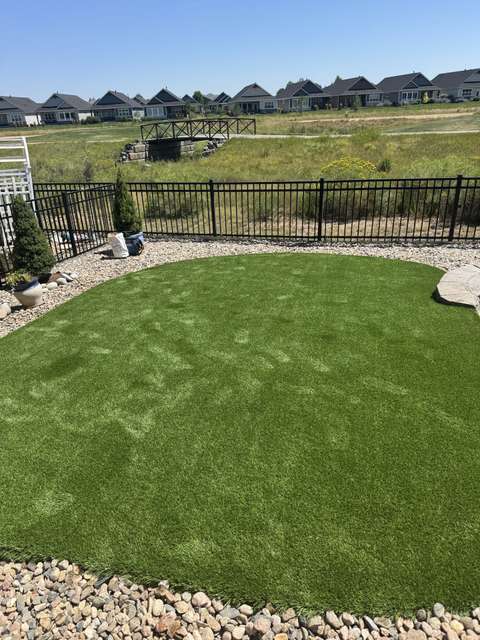
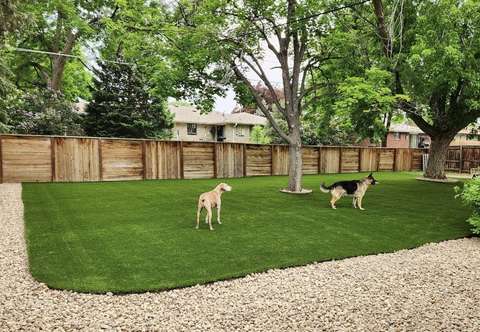

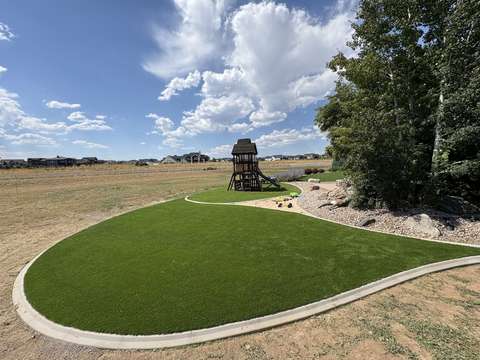
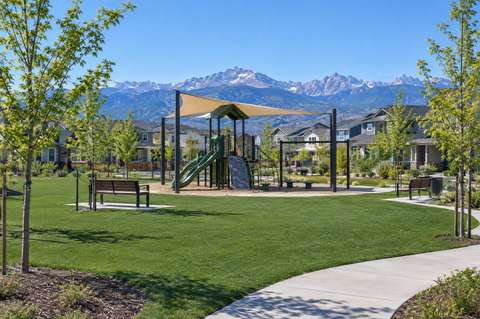


How it works.
Book a yard walk
Tell us about the yard. We’ll set a time to walk it with you, look at the ground and talk through what you want.
Get a plan and a price
We measure and give you the plan and the price in writing.
We install it
We take out the old lawn, build and compact the base for your soil, then lay, seam and edge the turf.
Walk it together
We brush it in, clean up, and walk the finished yard with you before we call it done.
Read up on putting greens.
Speed, break, cups, fringe and chipping: how to plan a backyard green you’ll actually use.
All 8 guidesCommon questions.
What happens if turf goes in before the committee approves it?
The declaration lets the committee order the work stopped, allow no more than 30 days to bring it into compliance, seek an injunction, and charge its costs to the lot as a lien. The HOA’s fee schedule starts with a warning, then $50, $100 and $150, with 72 hours to fix it or send a plan; a 2006 policy lists different fines. Which one applies is the board’s call; ask it.
Is the Colony Pointe HOA still reviewing yards while dues are suspended?
Yes, as far as the record shows. The covenants run with the title to every lot, dues or no dues. Colorado’s registry lists the association, formed in 2000, in good standing, and its documents page still posts the architect review form. Owners at the 2024 meeting described a covenant-style HOA with limited board activity, so allow time for an answer and keep a copy of everything you send.
Who looks after the back fence on Alice Avenue or Inez Boulevard?
The HOA’s site says owners keep up the house side of that wooden perimeter fence and the HOA the street side, but owners at the 2024 meeting voted that after a fall staining its upkeep would pass to homeowners. The green beyond it on Alice Avenue belongs to a metro district, not the HOA. The two documents differ; ask the board before a green is built against that fence.
Could the HOA lay artificial turf on its own common ground?
The association itself owns one small outlot, about 0.84 acre. Milliken bars nonfunctional artificial turf on HOA common property in new development and redevelopment, while Colorado’s 2025 amendment counts turf in a recreation area, such as a playground, a sports field or part of a park, as functional and outside that ban. It depends on the project and its use; ask Milliken Planning before the board plans one.
The fine printColony Pointe’s design rules, in fullOpen
Colony Pointe, on the record
- The place
- Lake community
- Design review
- Colony Pointe Homeowners AssociationHomeowners association
- Town
- Milliken, COWeld County
Backyard turf, a green or a new fence all need the committee’s written approval first.
Nowhere do Colony Pointe’s covenants use the words artificial turf or putting green; they review landscaping as a whole.
Article XI, Section 2 of the declaration recorded in December 2001 reads: “No buildings, structures or other Improvements including fences and landscaping shall be constructed, modified or altered unless first approved in writing by the Architectural Review Committee.” The declaration counts landscaping and sprinkling systems among those Improvements, so pulling up sod or moving sprinkler heads is a change for the committee too.
Its test is harmony. The committee is to use reasonable judgment so each change will “conform to and harmonize with existing surroundings and structures”, and it may deny one it reasonably decides does not. The covenants also point owners to mandatory landscaping requirements in Architectural Design Standards the committee adopts, yet the HOA’s posted papers hold none beyond Exhibit B, whose recorded minimums deal with houses, grading and driveways rather than planting. What Colorado law says about HOAs and backyard turf is in the HOA approval guide.
Colorado law · the same in every town
On a detached home, an HOA can shape backyard turf. It can’t ban it.
Colorado law says an HOA's landscaping rules may not prohibit artificial turf in the backyard of a detached single-family home, although the HOA can still adopt design and aesthetic guidelines.
ASSOCIATIONS MAY ADOPT AND ENFORCE DESIGN OR AESTHETIC GUIDELINES OR RULES THAT APPLY TO DROUGHT-TOLERANT VEGETATIVE OR NONVEGETATIVE LANDSCAPES … EXCEPT THAT THE GUIDELINES OR RULES MUST: (A) NOT PROHIBIT THE USE OF NONVEGETATIVE TURF GRASS IN THE BACKYARD OF A UNIT OWNER'S PROPERTY
Read the signed actChecked Sep 24, 2026
Homes that share a wall
For attached single-family homes that share a wall, such as townhomes, Colorado law lets an HOA restrict artificial turf to rear yards only.
C.R.S. 38-33.3-106.5(1)(i)(I)(A)Front yards
Colorado law requires each HOA to pre-approve at least 3 water-wise garden designs for front yards, while its artificial-turf protection covers backyards only.
C.R.S. 38-33.3-106.5(1)(i.5)(II)Special districts
Colorado law makes unenforceable any HOA covenant or special-district rule that prohibits artificial turf in the backyard of a residential property, except for attached homes and timeshare associations.
C.R.S. 37-60-126(11)(a.5)If an HOA ignores it
If an HOA knowingly violates these Colorado landscaping protections, the homeowner must give written notice and 45 days to cure before suing for up to $500 or actual damages, whichever is greater.
C.R.S. 38-33.3-106.5(1)(i.5)(III)
A contoured green can’t reshape the lot’s grading or drainage without approval.
Section 9(aa) bars any owner from changing “the topography or drainage pattern of a Lot” from what the declarant set, unless the committee approves. An owner who does it anyway answers for the damage and may have to put the ground back. Exhibit B adds that the grading and design of each lot “is shown on the recorded Plat and must be adhered to”, with exterior grading carrying water away from the house and the houses beside it.
That decides how a green is built here. Breaks and tiers belong in the compacted base, inside the fall the lot already has, rather than in new fill that turns runoff toward a neighbor or back at a foundation. A site plan with the drainage path marked on it belongs in the submittal. Exhibit B also discourages “large elevated decks or patios”, so seating laid at grade beside the green is an easier fit than a raised deck overlooking it.
The committee has 30 days to answer a complete plan, and silence can turn into approval.
The declaration’s minimum submittal is a site plan, complete construction plans, and specifications with color schemes and material samples, plus any review costs the committee asks for up front. The HOA’s own form is lighter: a description of the work with its size, color, materials and location, and at least one plan, brochure, sample or photo. A form sent back without a sample or plan will not be reviewed.
Once everything is in, the committee has 30 days to approve or reject in writing, giving reasons and, where practical, the changes that would pass. If that deadline goes by, the owner notifies the committee in writing by certified mail, return receipt requested; if 15 more days pass without an answer, the plans as submitted are deemed approved. If the committee asks for more documents, neither period starts until they are in. After the work, the owner reports completion and the committee may inspect.
The clock matters more than usual here. The HOA has suspended dues for 2025 through 2027 and stopped writing status letters because of the board’s limited availability, and its 2024 meeting described a covenant-style HOA with limited board activity. The declaration still calls for a committee of at least 3 members. It depends on who is serving when a plan goes in: ask the board where to send it, since the form lists the HOA’s post office box and the documents page asks for paint forms by email.
A new fence on the park side needs the committee’s approval and has to be at least half open.
The Town of Milliken owns and operates Ehrlich Park and Ehrlich Lake and the trails around them, and on the county’s parcel roll it holds Colony Pointe’s two largest outlots, about 17.6 and 3.5 acres. A house that backs onto that land has a public park and its trails on the other side of the back fence.
Two sets of rules meet at that property line. The covenants require the committee’s written approval for fencing of any type. Milliken’s fence standards, which reach houses already built, call for a permit before construction and want a side or rear fence beside a park or open space to be at least 50 percent open; the code lists split rail, picket and wrought iron. Owners raised lake-side fencing at the November 2023 homeowners meeting as something for the HOA and the Town to settle, so ask both before a fence is ordered to frame a green.
A pet area raises the same sight-line question. The covenants want a dog run approved first and kept off any spot where it is visible from a street or public view. Whether a yard seen from the park trail counts as public view is the committee’s call; ask it before turf for the dogs goes along the back fence.
Colony Pointe is zoned as a planned unit development, so its recorded plan may set different yard rules.
Milliken’s zoning map puts all 247 Colony Pointe parcels inside a Planned Unit Development zone rather than an ordinary single-family district. Milliken’s code says land use in a PUD approved under it is “controlled by the provisions of the approved PUD MDP and FDP”, the master and final development plans, which may set their own dimensions and uses and are filed with Weld County and the Town Clerk. Colony Pointe’s PUD is older than the current code and its plan is not posted online, so whether that plan or the Town’s standard districts decide a green’s coverage and setbacks depends on the recorded documents; ask Milliken Planning or the Town Clerk for a copy. The committee enforces the same building setbacks the Town requires.
Two more Town rules reach every lot. Existing detached houses are exempt from most of Milliken’s Division 3 landscape standards. And the covenants allow no individual water supply system on any lot, tying each house to water and sewer under the Town’s ordinances; Milliken’s sprinkler hours for town-treated water are on the Milliken page.
Most lots run about 6,600 to 7,500 square feet, so the green and the patio are one plan.
Weld County’s parcel data counts 241 house lots across Colony Pointe and its Filing Two, around a median of about 0.16 acre, near 6,900 square feet. The middle half fall between about 6,600 and 7,500 square feet, and the largest is near 0.27 acre. The HOA’s own count is 233 detached homes.
At that size the back yard works as one composition: the green and its fringe, a seating area at grade, the path to the side gate and any shed or pergola, drawn on the same site plan the committee will read. The covenants want written consent for a shed or other accessory building, but say such structures “shall not be unreasonably prohibited” so long as their materials, colors and placement are fully considered.
Design review · Colony Pointe Homeowners Association
What the guidelines say about turf and the backyard.
Quoted from the posted guidelines, each with the date it was read. Colorado’s backyard rule sits over all of them: what the law says.
Colony Pointe's recorded declaration, which runs with the title to every lot, requires the Architectural Review Committee's written approval before any building, structure or other improvement, fences and landscaping included, is built, modified or altered, and lets the committee deny a change it reasonably finds out of harmony with its surroundings; it never mentions artificial turf or putting greens.
§ 2Checked Sep 27, 2026
Colony Pointe's covenants bar an owner from changing a lot's topography or drainage pattern without the committee's approval, hold each lot to the grading and design shown on the recorded plat, discourage large elevated decks or patios, and enforce the same building setbacks the Town of Milliken requires.
§ 9(aa)Checked Sep 27, 2026
Colony Pointe's declaration asks an applicant for a site plan, complete construction plans, specifications with color schemes and material samples, and payment of anticipated review costs; gives the committee 30 days from a complete submittal to approve or reject in writing; deems the plans approved if it still has not answered 15 days after the applicant's certified-mail notice; and lets the committee inspect the finished work.
§ 4Checked Sep 27, 2026
Sources for Colony Pointe, Milliken, each with the date it was read16
- Declaration of Covenants, Conditions, and Restrictions for Colony Pointe Subdivision, Arts. I and XI and Exhibit B (recorded Dec. 27, 2001, Weld County Reception No. 2912045), as posted by the HOA · checked Sep 27, 2026
- Colony Pointe HOA Milliken, home page and FAQ · checked Sep 27, 2026
- Colony Pointe HOA Milliken, HOA Documents page · checked Sep 27, 2026
- Colony Pointe HOA, Application for Approval of Architectural Improvement (Architect Review Form) · checked Sep 27, 2026
- Colony Pointe HOA Fee Schedule · checked Sep 27, 2026
- Colony Pointe Homeowners Association, Policy for Enforcement of Covenants and Rules (effective Jan. 1, 2006) · checked Sep 27, 2026
- Colony Pointe HOA, Homeowners Meeting Minutes, Nov. 8, 2023 · checked Sep 27, 2026
- Colony Pointe HOA, Homeowners Meeting Minutes, Aug. 1, 2024 · checked Sep 27, 2026
- Colorado Secretary of State, Business Entities in Colorado (data.colorado.gov dataset 4ykn-tg5h), Colony Pointe Homeowners Association · checked Sep 27, 2026
- Weld County GIS, Parcels_open_data layer (Colony Pointe Sub and Colony Pointe Sub FG#2: lot sizes and outlot owners) · checked Sep 27, 2026
- Town of Milliken zoning layer (Zoning_View_Only, ArcGIS feature service) · checked Sep 27, 2026
- Milliken Municipal Code Sec. 16-2-220, Planned Unit Development District (codified through Ord. No. 838, March 25, 2026) · checked Sep 27, 2026
- Milliken Municipal Code Sec. 16-3-390, Fences and Walls (codified through Ord. No. 838, March 25, 2026) · checked Sep 27, 2026
- Milliken Municipal Code Secs. 16-3-303 and 16-3-305(c) (Ord. 831, Dec. 22, 2025; codified through Ord. No. 838, March 25, 2026) · checked Sep 27, 2026
- SB23-178 signed act: C.R.S. 38-33.3-106.5(1)(i.5) · checked Sep 27, 2026
- HB25-1113 signed act: C.R.S. 37-99-102(6.5), functional artificial turf · checked Sep 27, 2026
Next step
Let’s walk your yard.
Tell us what you want and how to reach you. We’ll set a time to see the yard.
Book a yard walk
Five quick questions. Then we’ll reach out to set a time.
- 1Your project
- 2Your town
- 3Size
- 4HOA and timing
- 5Contact