

Harvest · Berthoud, CO
Turf and putting greens in Harvest.
What the neighborhood’s own rules say about turf and putting greens. When you’re ready, we’ll walk the yard with you.

- 4.7 on GoogleRead the reviews
- Based in WindsorWorking Wellington to Longmont
- Plan and price in writingBefore any work starts
Before you start in Harvest.
- The covenants don’t mention artificial turf, but the Architectural Review Committee must approve any landscaping in writing.
- Front yards must stay at least 30% lawn, and turf can’t go in the curbside strip.
- If the committee doesn’t answer within 30 days, the plan counts as denied, so follow up.
What we build.
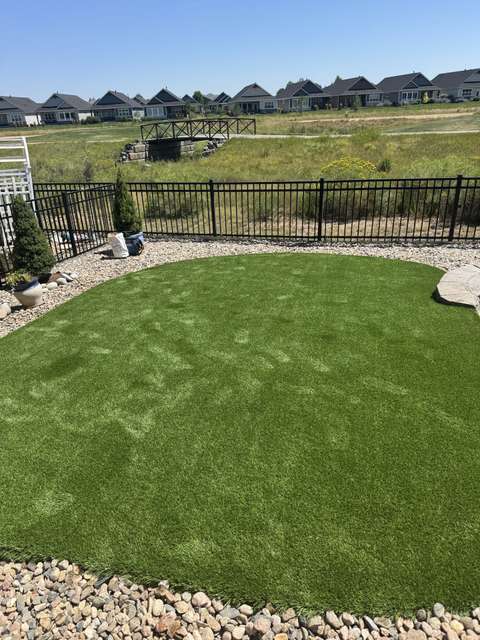
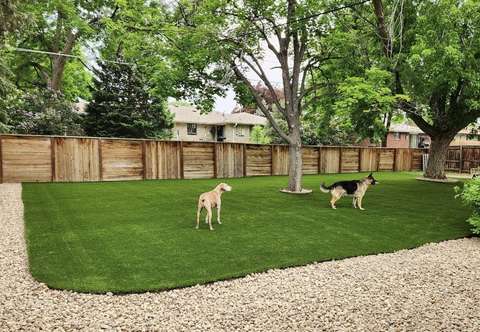
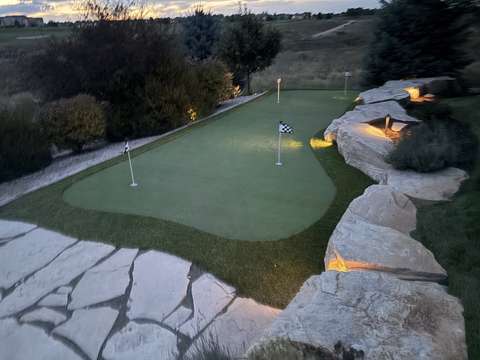
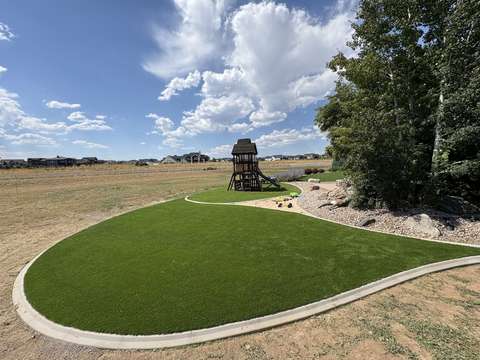


How it works.
Book a yard walk
Tell us about the yard. We’ll set a time to walk it with you, look at the ground and talk through what you want.
Get a plan and a price
We measure and give you the plan and the price in writing.
We install it
We take out the old lawn, build and compact the base for your soil, then lay, seam and edge the turf.
Walk it together
We brush it in, clean up, and walk the finished yard with you before we call it done.
More in Berthoud.
Other Berthoud neighborhoods.
Read up on putting greens.
Speed, break, cups, fringe and chipping: how to plan a backyard green you’ll actually use.
All 8 guidesCommon questions.
Does artificial turf count toward Harvest’s 30% front-lawn rule?
The Declaration doesn’t say: it never mentions artificial turf and doesn’t define lawn. It depends on how the Architectural Review Committee reads Section 2.19, so ask it in writing before drawing a front yard around synthetic grass. Colorado law also requires every HOA to pre-approve at least three water-wise garden designs for front yards; ask the committee for Harvest’s.
What happens if Harvest’s committee never answers my plan?
The plan is denied. Section 5.07 gives the committee 30 days from receiving everything it asked for, and plans it hasn’t acted on by then are deemed disapproved as submitted. Keep a dated copy of what you sent and follow up well before the 30 days run out. The HOA approval guide covers putting the request together.
When does a new Harvest home’s yard have to be finished?
Within 7 months of the certificate of occupancy, under Section 2.19. The builder’s application makes the backyard landscape plan due when that certificate arrives, so a green planned from the start goes on that plan, with the irrigated and non-irrigated square footage the form asks for.
Does the Town of Berthoud have a say in a Harvest yard?
Possibly. The town’s June 2026 landscape design guidelines say artificial turf in new Suburban and Old Town Residential projects belongs only in private backyards or on sports fields. Ask Berthoud Planning whether that line reaches a given Harvest lot before you plan turf out front. Harvest’s own change form adds that association approval is not a building permit.
Where does a Harvest yard’s water come from?
The Town of Berthoud, according to the community’s utilities page. When turf replaces lawn, plan the sprinklers with it: the Declaration lets spray heads serve only lawn or groundcover, wants the rest on drip, bubbler or subsurface lines, and asks for a controller that can water within any imposed restriction.
The fine printHarvest’s design rules, in fullOpen
Harvest, on the record
- The place
- Custom-home community
- Design review
- Harvest Owners Association, Inc.Homeowners association
- Town
- Berthoud, COLarimer & Weld counties
The Declaration sets a lawn share out front and never names artificial turf.
Harvest’s Declaration requires each front yard to be at least 30% lawn and says turf is not allowed in the street landscaping between curb and sidewalk. Neither line says whether synthetic grass counts.
The rest of a front yard may be rock mulch with trees, flowers and shrubs. The curbside strip is the builder’s to plant, with at least 1 shrub and 2 ornamental grasses for every 10 feet of street frontage.
Read in full on September 26, 2026, the Declaration, the 2021 supplement that brought Harvest Ridge South in and the 2022 amendment contain no mention of artificial turf, synthetic grass or putting greens. Whether a synthetic lawn counts toward the 30%, or falls under the curbside ban, depends on how the Architectural Review Committee reads Section 2.19; ask it in writing before you design a front yard around turf.
The back yard carries no lawn quota. What it does carry is a planting count along the house, 8 plants per 40 linear feet of rear foundation, and an irrigation rule: spray heads serve only lawn or groundcover, and every other planting gets drip, bubbler or subsurface lines.
Colorado law · the same in every town
On a detached home, an HOA can shape backyard turf. It can’t ban it.
Colorado law says an HOA's landscaping rules may not prohibit artificial turf in the backyard of a detached single-family home, although the HOA can still adopt design and aesthetic guidelines.
ASSOCIATIONS MAY ADOPT AND ENFORCE DESIGN OR AESTHETIC GUIDELINES OR RULES THAT APPLY TO DROUGHT-TOLERANT VEGETATIVE OR NONVEGETATIVE LANDSCAPES … EXCEPT THAT THE GUIDELINES OR RULES MUST: (A) NOT PROHIBIT THE USE OF NONVEGETATIVE TURF GRASS IN THE BACKYARD OF A UNIT OWNER'S PROPERTY
Read the signed actChecked Sep 24, 2026
Homes that share a wall
For attached single-family homes that share a wall, such as townhomes, Colorado law lets an HOA restrict artificial turf to rear yards only.
C.R.S. 38-33.3-106.5(1)(i)(I)(A)Front yards
Colorado law requires each HOA to pre-approve at least 3 water-wise garden designs for front yards, while its artificial-turf protection covers backyards only.
C.R.S. 38-33.3-106.5(1)(i.5)(II)Special districts
Colorado law makes unenforceable any HOA covenant or special-district rule that prohibits artificial turf in the backyard of a residential property, except for attached homes and timeshare associations.
C.R.S. 37-60-126(11)(a.5)If an HOA ignores it
If an HOA knowingly violates these Colorado landscaping protections, the homeowner must give written notice and 45 days to cure before suing for up to $500 or actual damages, whichever is greater.
C.R.S. 38-33.3-106.5(1)(i.5)(III)
In Harvest, a plan the committee leaves unanswered for 30 days is denied.
Section 5.03 gives the Architectural Review Committee sole authority over any material change to a lot and lists the planting of lawns among them. No work starts before it approves, and only a written approval counts. For as long as the developer, HT Land Partners, owns any part of Harvest, it serves as that committee, unless it records an earlier end to that role.
The committee has 30 days from receiving everything it asked for. Plans it has neither approved nor disapproved by then are deemed disapproved as submitted, so silence is a no. It may refuse on purely aesthetic grounds and may attach changes to a yes.
An approval lapses if work hasn’t started within one year, and the work must be finished within one year of starting. The committee can hand an application to a landscape architect or other professional at the owner’s cost, and the Board sets any filing fee.
A green reaches the committee drawn to scale, with its drainage and a planting table.
The Declaration’s checklist for landscape plans wants a written and graphic scale, a north arrow, the house, decks, patios, fences and lot lines, every existing or proposed landscape element and light, specifications and a picture of any large feature, grading and drainage, a table of required against provided trees and plantings, and the type, size and color of any mulch or rock. The request goes in writing with two complete sets of plans.
On a new build, the builder’s application makes the backyard landscape plan due when the home is finished and the certificate of occupancy is in, showing the square footage of irrigated and non-irrigated ground. That plan is the place to draw a green. Later changes go on the ancillary modification form, which asks for a diagram of the location and notes that association approval is not a building permit.
The covenants’ own pictures favor patios past the house, outdoor kitchens and rock steps.
Appendix A, the Declaration’s illustrated list of encouraged and discouraged architecture, gives rear outdoor living a page of its own. It encourages patio and seating that extend past the house, covered patios with wood columns, an outdoor kitchen, rock landscaped steps, walkout patios and rock that carries a change in grade. On lots backing north it highly encourages a detailed rear, to keep curb appeal from the street.
Houses follow a Modern Farmhouse style with Modern Mountain accents, in subdued colors that blend with the landscape and with brick or stone on the front, which gives a backyard its material cues. The Declaration lists 31 lots in Harvest Ridge North, one in Johnson Subdivision Filing 2 and 65 planned in Harvest Ridge South; they run 0.22 to 0.35 acres, and houses sit at least 10 feet from each side line.
The same Declaration keeps play structures out of front and side yards and no taller than 15 feet, screens pools and hot tubs from neighbors and the street, wants water features filtered and sized to keep noise from next door, and asks that light sources not show off the lot where practicable, which bears on a lit green.
The 2021 soils study found lean clay that tends to trap water once yards are irrigated.
The preliminary study for Harvest Ridge South describes a roughly 30-acre farm field between Berthoud Parkway and Highway 287, draining poor to fair toward the Little Thompson River about a quarter mile south. Its borings found sandy lean clay and lean clay with sand to about 15 feet, with low expansive potential and low load-bearing capability.
It warns that perched groundwater may develop once landscaping and irrigation go in, because the clay is relatively impermeable and tends to trap water, and it asks for sprinklers to stay at least 5 feet from foundation walls, with the ground sloping away from the house. Under turf or a green, that points to a base graded to carry water away from the walls to somewhere it can leave, not one that pools on the clay.
The study covers Harvest Ridge South only and left lot-by-lot criteria to later explorations. Colorado requires the builder of a new home to give the buyer a soils report summary at least 14 days before closing; that is the document to read before a base is planned.
Harvest’s recorded fence rule and its website disagree, so settle the fence before the green.
A January 2022 amendment rewrote the fence section: every fence 5 feet high, wood-grain concrete or a similar material dyed a natural tan, in a split-rail style, apart from the privacy fencing along Berthoud Parkway and the south edge of Harvest Ridge South. The community website’s fencing page still shows 5-foot Bufftech in Weathered Blend and a Big Rail 4-rail horse fence as approved. The two conflict. It depends on which one the Architectural Review Committee applies, so ask it before a fence line is drawn around a green.
The shared ground is native grass by design. The HOA’s landscaping page says those grasses are trimmed a few times a year and conserve water, and that replacing them with sod would nearly double HOA fees. Harvest is not part of a metropolitan district, so no district design review sits on top of the association’s committee.
Design review · Harvest Owners Association, Inc.
What the guidelines say about turf and the backyard.
Quoted from the posted guidelines, each with the date it was read. Colorado’s backyard rule sits over all of them: what the law says.
Harvest's Declaration requires each front yard to be at least 30% lawn and lets the rest be rock mulch with trees, flowers and shrubs.
§ 2.19Checked Sep 26, 2026
Harvest's Declaration has the builder plant the strip between curb and sidewalk with at least 1 shrub and 2 ornamental grasses for every 10 feet of street frontage, and does not allow turf there.
§ 2.19Checked Sep 26, 2026
Harvest's Architectural Review Committee has sole authority to approve or disapprove any material change to a lot, landscaping and lawns included, and no work may start until it approves in writing.
§ 5.03(b)Checked Sep 26, 2026
Harvest's committee must approve or disapprove plans within 30 days of receiving everything it asked for, and plans it has not acted on by then are deemed disapproved.
§ 5.07Checked Sep 26, 2026
Sources for Harvest, Berthoud, each with the date it was read14
- Declaration of Covenants, Conditions, and Restrictions for Harvest (recorded July 1, 2021, Larimer County Reception No. 20210063769), with Appendix A · checked Sep 26, 2026
- Supplemental Declaration for Harvest, annexing Harvest Ridge South (recorded December 16, 2021) · checked Sep 26, 2026
- First Amendment to the Declaration for Harvest, replacing Sec. 2.12 Fences (recorded January 14, 2022) · checked Sep 26, 2026
- Harvest Declaration, Appendix A: Encouraged and Discouraged Architecture · checked Sep 26, 2026
- Harvest, Application for ARC New Construction (submittal checklist) · checked Sep 26, 2026
- Harvest, Application for ACC Ancillary Modification · checked Sep 26, 2026
- Northern Colorado Geotech, Preliminary Geotechnical Engineering Report, Harvest Ridge South (July 26, 2021) · checked Sep 26, 2026
- Berthoud Harvest community website, home page (lots and setbacks) · checked Sep 26, 2026
- Berthoud Harvest community website, FAQ (metro district) · checked Sep 26, 2026
- Berthoud Harvest community website, Fencing + Landscaping · checked Sep 26, 2026
- Berthoud Harvest community website, Utilities + Community Services · checked Sep 26, 2026
- Town of Berthoud Landscape Design Guidelines (updated June 30, 2026, Ordinance 1383) · checked Sep 26, 2026
- C.R.S. 38-33.3-106.5(1)(i.5), added by SB23-178 (signed act) · checked Sep 26, 2026
- C.R.S. 6-6.5-101(1), soils report disclosure to new-home buyers (text via Colorado.Public.Law) · checked Sep 26, 2026
Next step
Let’s walk your yard.
Tell us what you want and how to reach you. We’ll set a time to see the yard.
Book a yard walk
Five quick questions. Then we’ll reach out to set a time.
- 1Your project
- 2Your town
- 3Size
- 4HOA and timing
- 5Contact