

Thompson Crossing · Johnstown, CO
Turf and putting greens in Thompson Crossing.
What the neighborhood’s own rules say about turf and putting greens. When you’re ready, we’ll walk the yard with you.

- 4.7 on GoogleRead the reviews
- Based in WindsorWorking Wellington to Longmont
- Plan and price in writingBefore any work starts
Before you start in Thompson Crossing.
- Both design guides list synthetic turf as never permitted, but state law makes that unenforceable in a detached home’s back yard.
- Putting greens aren’t mentioned, so a green goes to the committee.
- Front and side yards are up to the Design Review Committee.
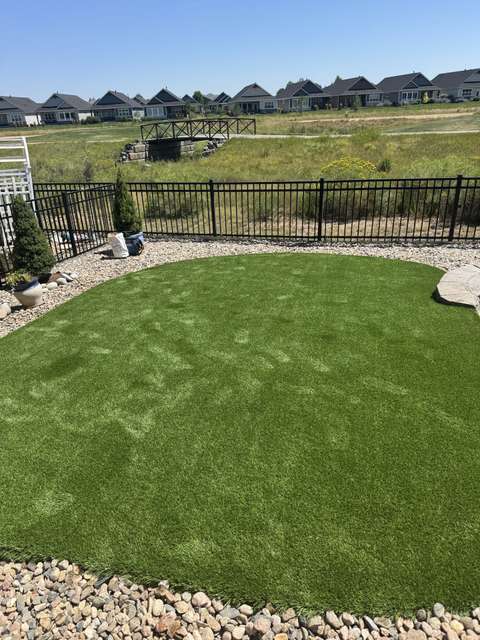
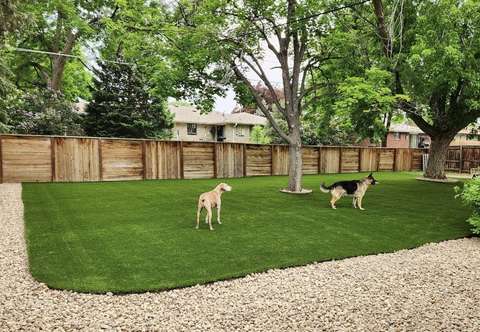
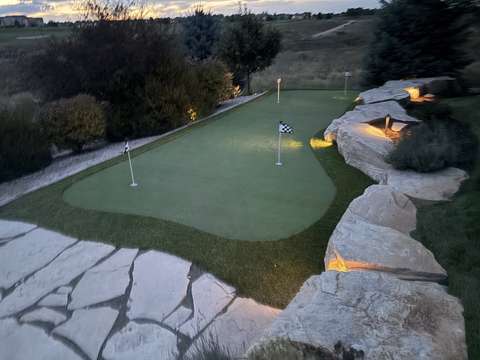
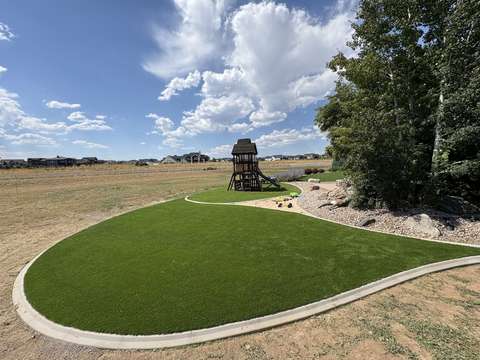
What we build.


How it works.
Book a yard walk
Tell us about the yard. We’ll set a time to walk it with you, look at the ground and talk through what you want.
Get a plan and a price
We measure and give you the plan and the price in writing.
We install it
We take out the old lawn, build and compact the base for your soil, then lay, seam and edge the turf.
Walk it together
We brush it in, clean up, and walk the finished yard with you before we call it done.
Read up on putting greens.
Speed, break, cups, fringe and chipping: how to plan a backyard green you’ll actually use.
All 8 guidesCommon questions.
Can I put artificial turf in a Thompson Crossing back yard?
On a detached home, yes. Both guides still list synthetic turf as not permitted, but Colorado law makes a covenant or rule that bans it in a back yard unenforceable; the state rule is printed on this page. The committee can still review the design, so the landscape plan goes in first. The HOA approval guide covers the request.
Do the Thompson Crossing guides say anything about putting greens?
No. Neither guide mentions one. Both send any improvement they don’t list to the committee for approval before work starts, and both want the type and location of play and sports equipment approved. A synthetic green is synthetic turf, so in a back yard the state rule on this page applies; anywhere else on the lot, ask the Design Review Committee.
Does Johnstown’s rear-yard turf cap reach Thompson Crossing?
Not by its own terms. Sec. 17-8-4 of the Town’s code caps turf and spray irrigation at half of a single-family back yard and 2,000 square feet, but exempts every lot platted before January 1, 2024, and the Thompson Crossing plats were recorded from 2006 to 2016.
What does the committee charge to review a turf or putting-green plan?
The 2006 guide lists $100 for landscape drawings on new construction, $50 for each resubmittal and $100 for a waiver request, with minor improvements free, and lets the committee adjust its fees. The Phase II guide prints no fee table. It depends on the association and on how it classes the project, so ask its committee before you submit.
Can I put a turf dog run in a Thompson Crossing yard?
With approval. Both guides make the committee approve the materials, colors and location of dog houses and dog runs, and the landscape plan has to show them. Rail fences are the rule here, so a dog area usually leans on the approved mesh inside the fence or a short privacy section near the house.
The fine printThompson Crossing’s design rules, in fullOpen
Thompson Crossing, on the record
- The place
- Estate lots
- Design review
- Thompson Crossing Community Association and Thompson Crossing II AssociationHomeowners association
- Town
- Johnstown, COWeld & Larimer counties
Synthetic turf is number 10 on the never-permitted list in both Thompson Crossing guides.
The lists date from 2006 and 2014, years before Colorado first named artificial turf in its HOA law in 2021.
Each guide ends its list of typical improvements with thirteen items that are “NOT PERMITTED under any circumstances”: clotheslines, evaporative coolers, free-standing flag poles, rooftop equipment, wells and, at number 10, synthetic turf. The landscape section then names the only grass it pictures, turf that “shall be a high quality Kentucky bluegrass or an approved drought tolerant fescue.”
Both guides also say they “do not modify or supersede” local, county, state or federal law: in a conflict, jurisdictional regulations take precedence and the most restrictive standard applies. Behind a detached home, the Colorado rule printed below is that jurisdictional regulation. In a front or side yard, or the strip a detached walk leaves along the street, it depends on the lot; ask the Design Review Committee before a plan shows turf there.
Colorado law · the same in every town
On a detached home, an HOA can shape backyard turf. It can’t ban it.
Colorado law says an HOA's landscaping rules may not prohibit artificial turf in the backyard of a detached single-family home, although the HOA can still adopt design and aesthetic guidelines.
ASSOCIATIONS MAY ADOPT AND ENFORCE DESIGN OR AESTHETIC GUIDELINES OR RULES THAT APPLY TO DROUGHT-TOLERANT VEGETATIVE OR NONVEGETATIVE LANDSCAPES … EXCEPT THAT THE GUIDELINES OR RULES MUST: (A) NOT PROHIBIT THE USE OF NONVEGETATIVE TURF GRASS IN THE BACKYARD OF A UNIT OWNER'S PROPERTY
Read the signed actChecked Sep 24, 2026
Homes that share a wall
For attached single-family homes that share a wall, such as townhomes, Colorado law lets an HOA restrict artificial turf to rear yards only.
C.R.S. 38-33.3-106.5(1)(i)(I)(A)Front yards
Colorado law requires each HOA to pre-approve at least 3 water-wise garden designs for front yards, while its artificial-turf protection covers backyards only.
C.R.S. 38-33.3-106.5(1)(i.5)(II)Special districts
Colorado law makes unenforceable any HOA covenant or special-district rule that prohibits artificial turf in the backyard of a residential property, except for attached homes and timeshare associations.
C.R.S. 37-60-126(11)(a.5)If an HOA ignores it
If an HOA knowingly violates these Colorado landscaping protections, the homeowner must give written notice and 45 days to cure before suing for up to $500 or actual damages, whichever is greater.
C.R.S. 38-33.3-106.5(1)(i.5)(III)Where the rule started
Colorado first listed artificial turf among the landscaping an HOA may regulate but not prohibit in a backyard in 2021, through HB21-1229.
HB21-1229
A putting green never appears in either guide, so it goes to the committee like any unlisted improvement.
Anything the guides don’t list still needs the committee’s written approval before work starts.
The Design Review Committee approves all architectural and landscape designs, and the 2006 guide lets it refuse one on design or style even when every minimum is met. Landscaping plans come from a professional landscape designer, unless the committee waives that for the applicant’s background, and go in as two sets on 24-by-36-inch sheets with the review fee. The drawing has to locate the turf areas, the edging and any special landscape feature.
A green brushes against several listed items. Play and sports equipment and swing sets need approval of type and location, and landscape lighting has to stay conventional, with no glow that becomes a nuisance next door. The committee approves, approves with conditions or denies; the Phase II guide promises a letter within 30 days of a submittal. A written waiver request that goes unanswered for 30 days, is resubmitted and goes unanswered another 30 is deemed approved under both guides.
Phase I and Phase II each have an association, and the posted Phase II guide has no address.
Colorado’s business registry lists Thompson Crossing Community Association, formed in August 2006, and Thompson Crossing II Association, formed in January 2016, both nonprofits in good standing. The 2006 guide sends plans to the first association’s committee. The Phase II guide addresses a Thompson Crossing Phase II Community Association committee, but the copy the Town posts prints “Address Line 1” where the address belongs and leaves its architectural reviewer to be determined.
That guide hands the Town of Johnstown’s own review committee the residential models and major changes to the development’s features or amenities, and names no role for it in a single lot’s landscaping. Both guides tell owners to request the most current revision, and the Town’s copies carry 2006 and 2014 dates. Ask your association which committee reviews your filing, and for its current guide, before a designer starts drawing.
Lots on the 2006 plat have a median near 11,200 square feet; Phase II lots sit nearer 8,000.
Larimer County’s records show six Thompson Crossing plats on about 180.7 acres: the 2006 plat with replats in 2008 and 2010, then the Thompson Crossing II filings of 2015 and 2016. Measured from the county’s lot polygons, the 316 numbered lots have a median of about 9,200 square feet. The 149 lots from the 2006 plat and its replats reach about 28,600 square feet, 26 of them at 15,000 or more; the 167 Phase II lots top out near 23,000.
The guides sort every lot as Estate, Large or Standard, and the Phase II guide counts a lot 80 feet wide or more as an Estate lot. On one of the bigger early lots, a putting green, a turf play area and planting beds can share the space behind the house; a Phase II lot near the median leaves less to divide, and the landscape plan has to choose.
The landscape rules guard the neighbors’ views and keep lot lines soft.
Trees and large shrubs may not block neighboring views of the open spaces, the Thompson River valley or the Rocky Mountains, and the guides steer designs away from formal plantings, hard edges, mow curbs or anything else that draws a lot line. Landscaping next to native open space should blend into it, and retaining walls should stay low and natural enough to read as an outcropping.
Around a green or a turf lawn, that points to low planting and an edge that curves away from the property line rather than tracing it. Fences stay open: side and rear fences copy the community’s rail fence, two rails on the 2006 plat and three in Phase II, with approved mesh allowed on the inside. Privacy fencing must sit within 20 feet of the house and run 35 feet at most, and a dog run needs the committee’s approval of its materials, colors and location.
Canal water irrigates the 2006 lots from about May through September, and the guides want sprinklers in every yard.
The 2006 guide puts every lot on a dual water system: Town potable water inside the house, and non-potable irrigation water piped to the landscape while the irrigation canals run, typically May through September. Watering outside that window means the house’s own potable water through spigots and hoses, and the greenbelts run on the non-potable system too. The Phase II guide drops the paragraph, so ask whether a Phase II lot shares that system.
Both guides also require an automatic, clock-activated, buried sprinkler system throughout all yards. A turf area or a synthetic green draws none of that canal water, but whether its sprinkler zone may be capped under the “throughout” wording is a question for the committee. A turf base has to respect the drainage rule as well: no change to the lot’s established drainage pattern, and none that harms an adjoining lot.
Design review · Thompson Crossing Community Association and Thompson Crossing II Association
What the guidelines say about turf and the backyard.
Quoted from the posted guidelines, each with the date it was read. Colorado’s backyard rule sits over all of them: what the law says.
Both Thompson Crossing design guides, from 2006 and 2014, list synthetic turf among the items not permitted under any circumstances.
Thompson Crossing Phase 2 Design Guidelines (created 12/13/2013Checked Sep 25, 2026
Thompson Crossing's 2006 design guide requires its Design Review Committee to review and approve all architectural and landscape designs and lets the committee deny a design on design or style even when the minimum square footages and other requirements are met.
Thompson Crossing Design Guidelines (created 09/06/2005Checked Sep 26, 2026
Both Thompson Crossing design guides require landscape plans designed by a professional landscape designer and call for turf of high-quality Kentucky bluegrass or an approved drought-tolerant fescue.
Thompson Crossing Design Guidelines (revised 07/11/2006)Checked Sep 26, 2026
Thompson Crossing's landscape plan submittal to its design review committee must show the location and species of turf areas, the location and type of edging, playground areas and any other special landscape features, and dog houses and dog runs.
Thompson Crossing Design Guidelines (created 09/06/2005Checked Sep 25, 2026
Thompson Crossing's design guides require the committee's written approval before any listed improvement is built and say an improvement they do not list must still go to the committee for review and approval.
Thompson Crossing Design Guidelines (revised 07/11/2006)Checked Sep 26, 2026
Sources for Thompson Crossing, Johnstown, each with the date it was read9
- Thompson Crossing Design Guidelines (created 09/06/2005, revised 07/11/2006), posted by the Town of Johnstown · checked Sep 26, 2026
- Thompson Crossing II Design Guidelines (created 12/13/2013, revised 4/21/2014), posted by the Town of Johnstown · checked Sep 26, 2026
- Town of Johnstown, Planned Unit Development (PUD) Design Guidelines page · checked Sep 26, 2026
- Colorado Secretary of State, Business Entities in Colorado (data.colorado.gov): Thompson Crossing Community Association and Thompson Crossing II Association · checked Sep 26, 2026
- Larimer County parcel GIS, Subdivisions layer: the six Thompson Crossing plats · checked Sep 26, 2026
- Larimer County parcel GIS, Platted Lots layer: Thompson Crossing lots, areas computed from the lot polygons · checked Sep 26, 2026
- Johnstown Land Use and Development Code, Sec. 17-8-4(E)(2)(a) (Town PDF, effective December 5, 2023) · checked Sep 26, 2026
- SB23-178 signed act: C.R.S. 38-33.3-106.5(1)(i.5) and 37-60-126(11)(a.5) · checked Sep 26, 2026
- HB21-1229 bill summary, Colorado General Assembly · checked Sep 26, 2026
Next step
Let’s walk your yard.
Tell us what you want and how to reach you. We’ll set a time to see the yard.
Book a yard walk
Five quick questions. Then we’ll reach out to set a time.
- 1Your project
- 2Your town
- 3Size
- 4HOA and timing
- 5Contact