

Artificial turf · Estes Park, CO
Artificial turf in Estes Park.
We build turf lawns, dog runs and putting greens in Estes Park, on a base made for rocky, sloped ground and a long snowy winter.

- 4.7 on GoogleRead the reviews
- Based in WindsorWorking Wellington to Longmont
- Plan and price in writingBefore any work starts
What we build.
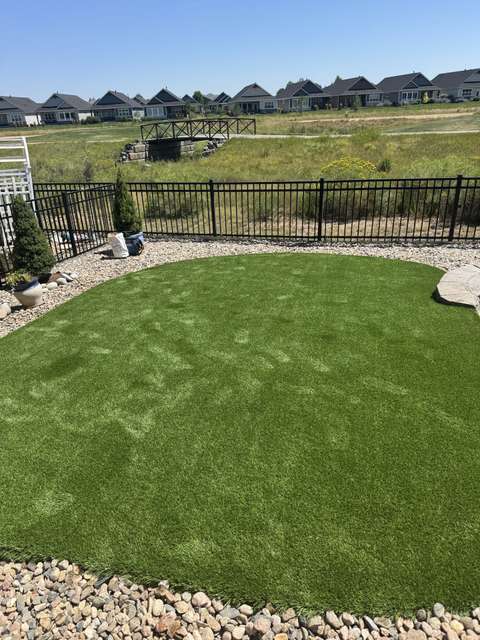
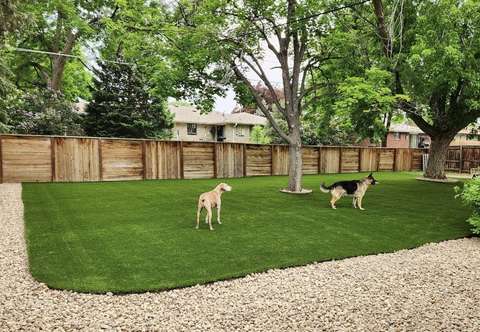
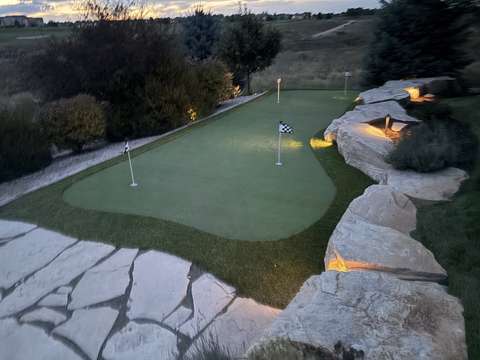
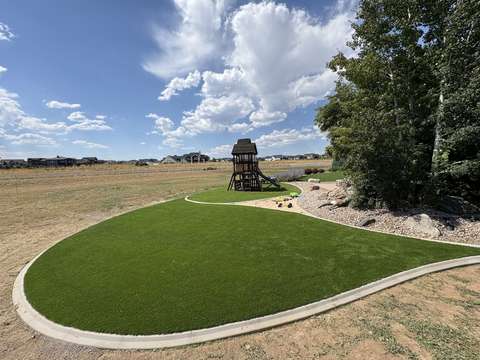


Before you start in Estes Park.
- Estes Park’s codes have no turf rule, so turf in your yard is up to you and your HOA.
- On a household-use well, you can’t water a lawn at all. Turf needs no watering.
- Bedrock can sit a foot down, so the base is built around the rock.
How it works.
Book a yard walk
Tell us about the yard. We’ll set a time to walk it with you, look at the ground and talk through what you want.
Get a plan and a price
We measure and give you the plan and the price in writing.
We install it
We take out the old lawn, build and compact the base for your soil, then lay, seam and edge the turf.
Walk it together
We brush it in, clean up, and walk the finished yard with you before we call it done.
Common questions.
Can I put artificial turf in my yard in Estes Park?
We found no Town rule against it: neither the Estes Park Development Code nor the Municipal Code mentions artificial turf, and the development code’s landscape standards are written for new subdivisions and development plans. If you’re in an HOA, its design review still applies, and Colorado law bars an HOA from banning turf in the backyard of a detached home.
My house is on a well. Can I water a lawn?
Check your well permit. CSU Extension notes that most wells drilled since May 8, 1972 on lots under 35 acres are permitted for household use only, which rules out any outside use. Turf needs no watering, but on a household-use well even rinsing it counts as outside use, so read the permit first.
What happens to artificial turf under Estes Park snow?
It sits under the snow the way a lawn does and is there when it melts. If you clear a path or a dog spot, use a plastic shovel or a leaf blower and leave a thin layer; our snow removal guide covers the rest, including which ice melts to keep off it.
We also work nearby.
Every town has its own turf rules. Pick yours to see them.
- Loveland25 mi eastWe build turf lawns and putting greens in Loveland, from Mariana Butte to the Lakes at Centerra.
- Berthoud30 mi eastWe build turf and putting greens all over Berthoud, from Heron Lakes at TPC Colorado to the acreage west of town, on a base made to stay flat on its clay.
- Fort Collins28 mi northeastWe build turf lawns, dog runs and putting greens across Fort Collins, made for its clay and Front Range snow.
- Windsor33 mi eastWindsor is home. We build turf and putting greens in Highland Meadows, RainDance, Water Valley and every street in between.
The fine printEstes Park’s turf rules and water rates, in fullOpen
Estes Park’s codes don’t mention artificial turf.
We searched both of the Town’s codes, the Estes Park Development Code and the Municipal Code, for artificial turf, synthetic turf and artificial grass, and neither has a rule about them. The only place the word turf comes up is the irrigation standard for newly installed landscapes, which asks for drip lines in the areas that aren’t turf.
The development code’s landscape standards, in Section 7.5, apply to residential subdivisions created after the code was adopted and to development that needs a development plan review. If your yard isn’t part of either, they aren’t written for it, and Community Development can confirm. The Town is updating its development code through 2025 and 2026, so it’s worth a call before you plan.
Town water ends at a mapped edge, and a well may not water a lawn at all.
The Town of Estes Park’s Water Division serves about 5,000 accounts. Its area runs from the east edge of town to the turn-in to Eagle Rock School on Dry Gulch Road, McCreery Lane on Devil’s Gulch Road, the southwest side of Carriage Hills off Highway 7, the Fish Hatchery area off Fall River Road and the Thunder Mountain Subdivision.
Outside that area, a home’s water comes from another provider or its own well. CSU Extension notes that most private wells drilled since May 8, 1972 on lots under 35 acres are permitted for household use only, and that their water can’t be used for any outside use. If your permit says household use only, a watered lawn isn’t allowed, and turf needs no watering.
Estes Park averages 104 inches of snow and a frost-free season of about 109 days.
The nearest NOAA station averages 104 inches of snow and 17.42 inches of precipitation a year, with 183.6 nights at or below freezing (1991–2020 normals). In a typical year the last spring freeze comes around May 30 and the first fall freeze around September 17, a frost-free season of about 109 days.
That is a short window to get sod or seed to take, and a long season of snow on the yard. Turf has nothing to establish, and summer heat is rarely the issue it is on the plains: the same station averages 1.7 days a year at or above 90°F.
Much of central Estes Park sits on shallow, rocky soil over bedrock.
Soil surveys around central Estes Park map mostly Cathedral-Ratake complexes on 5 to 35 percent slopes, where bedrock can sit about 10 to 15 inches down, and rock-outcrop complexes over about a quarter of the area sampled.
On the plains the problem is clay that swells. Here it is rock and grade: a crew can meet rock before it reaches a normal base depth, and on a slope the turf has to be fastened so it doesn’t creep. Soils change from lot to lot, which is why the yard walk comes first.
More than a third of Estes Park homes sat empty on Census day.
On Census day in April 2020, 1,587 of Estes Park’s 4,378 homes were vacant, about 36%. In a town where so many houses sit empty for weeks at a time, a lawn still needs water and mowing while nobody is there to do it. Turf doesn’t, and it looks the same the day you come back.
Colorado law · the same in every town
On a detached home, an HOA can shape backyard turf. It can’t ban it.
Colorado law says an HOA's landscaping rules may not prohibit artificial turf in the backyard of a detached single-family home, although the HOA can still adopt design and aesthetic guidelines.
ASSOCIATIONS MAY ADOPT AND ENFORCE DESIGN OR AESTHETIC GUIDELINES OR RULES THAT APPLY TO DROUGHT-TOLERANT VEGETATIVE OR NONVEGETATIVE LANDSCAPES … EXCEPT THAT THE GUIDELINES OR RULES MUST: (A) NOT PROHIBIT THE USE OF NONVEGETATIVE TURF GRASS IN THE BACKYARD OF A UNIT OWNER'S PROPERTY
Read the signed actChecked Sep 24, 2026
Homes that share a wall
For attached single-family homes that share a wall, such as townhomes, Colorado law lets an HOA restrict artificial turf to rear yards only.
C.R.S. 38-33.3-106.5(1)(i)(I)(A)Front yards
Colorado law requires each HOA to pre-approve at least 3 water-wise garden designs for front yards, while its artificial-turf protection covers backyards only.
C.R.S. 38-33.3-106.5(1)(i.5)(II)Special districts
Colorado law makes unenforceable any HOA covenant or special-district rule that prohibits artificial turf in the backyard of a residential property, except for attached homes and timeshare associations.
C.R.S. 37-60-126(11)(a.5)If an HOA ignores it
If an HOA knowingly violates these Colorado landscaping protections, the homeowner must give written notice and 45 days to cure before suing for up to $500 or actual damages, whichever is greater.
C.R.S. 38-33.3-106.5(1)(i.5)(III)
Sources for Estes Park, each with the date it was read8
- Estes Park Development Code §7.5.B, Landscaping and Buffers (codified through Ord. No. 09-25, June 24, 2025) · checked Sep 30, 2026
- Estes Park Municipal Code on Municode (Supplement 35 Update 3, May 26, 2026) · checked Sep 30, 2026
- Town of Estes Park, Estes Park Development Code and Comprehensive Plan (Development Code Updates 2025-2026) · checked Sep 30, 2026
- Town of Estes Park, Water Division · checked Sep 30, 2026
- CSU Extension, Gilpin County: Colorado Water Law and How to Garden Anyway (Irene Shonle) · checked Sep 30, 2026
- NOAA NCEI U.S. Climate Normals 1991–2020, station ESTES PARK 3 SSE (USC00052761) · checked Sep 30, 2026
- USDA-NRCS Soil Data Access (SSURGO), point-grid query around central Estes Park · checked Sep 30, 2026
- U.S. Census Bureau, 2020 Census Redistricting Data (P.L. 94-171), Colorado, Table H1: Estes Park 4,378 housing units, 1,587 vacant · checked Sep 24, 2026
Next step
Let’s walk your yard.
Tell us what you want and how to reach you. We’ll set a time to see the yard.
Book a yard walk
Five quick questions. Then we’ll reach out to set a time.
- 1Your project
- 2Your town
- 3Size
- 4HOA and timing
- 5Contact