

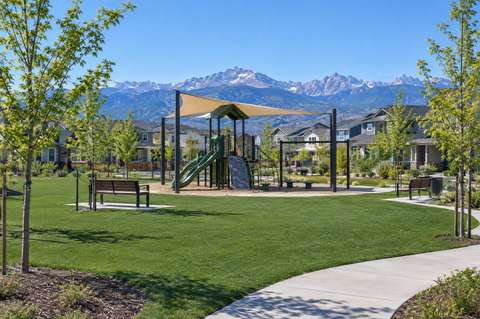
Spring Valley at Ute Creek · Longmont, CO
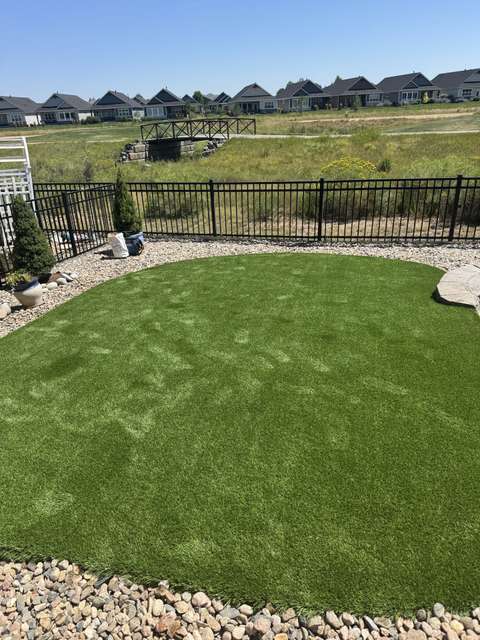
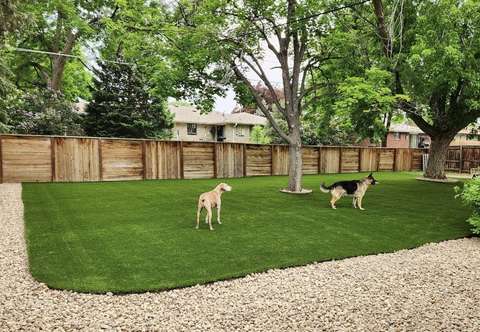
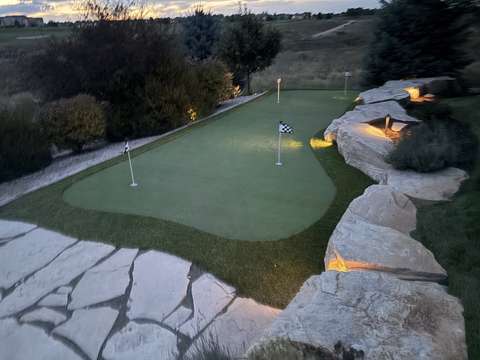
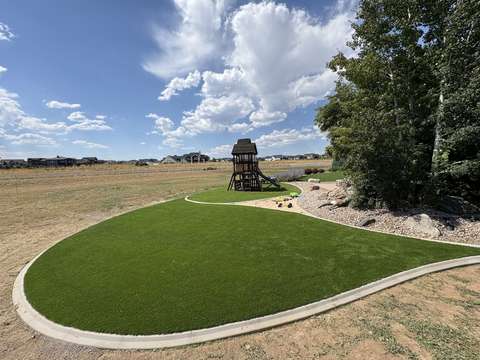
Turf and putting greens in Spring Valley at Ute Creek.
What the neighborhood’s own rules say about turf and putting greens. When you’re ready, we’ll walk the yard with you.

- 4.7 on GoogleRead the reviews
- Based in WindsorWorking Wellington to Longmont
- Plan and price in writingBefore any work starts
Before you start in Spring Valley at Ute Creek.
- Turf is allowed in rear yards with the committee’s written approval.
- It has to be professionally installed and UV-protected, and front yards stay at least 30% vegetation.
- If the committee says nothing in 30 days, the answer is no, so follow up.
What we build.


How it works.
Book a yard walk
Tell us about the yard. We’ll set a time to walk it with you, look at the ground and talk through what you want.
Get a plan and a price
We measure and give you the plan and the price in writing.
We install it
We take out the old lawn, build and compact the base for your soil, then lay, seam and edge the turf.
Walk it together
We brush it in, clean up, and walk the finished yard with you before we call it done.
More in Longmont.
Read up on putting greens.
Speed, break, cups, fringe and chipping: how to plan a backyard green you’ll actually use.
All 8 guidesCommon questions.
Can artificial turf go in a Spring Valley at Ute Creek front yard?
No. Section 2.36 keeps artificial turf to rear yards, front yards must hold at least 30% vegetation, and all-rock front yards are banned; Section 2.25 also keeps turf off walks, front steps and decks. Colorado requires every HOA to pre-approve at least three water-wise front-yard designs, and none is listed on the association’s Flagstaff page, so ask the ARC which ones it has chosen. What state law changes for backyards is on our HOA turf approval page.
I live in Spring Valley Golf Estates. Do these rules apply to me?
No. Golf Estates is a separate planned community with its own association, declared in 2000 with 51 lots and room for up to 160, though Flagstaff Management handles both. Its rules, amended April 24, 2018, require at least 50% sod in each lot’s front and back yards unless its ARC approves otherwise, with in-ground sprinklers front and back. Requests go in at least 30 days before work starts, and the approved form stays in a front window until the job is finished. How that sod minimum sits with Colorado’s backyard turf law is a question for the Golf Estates ARC; see HOA turf approval.
I want turf for a dog on a course lot. What do the documents say?
They allow for it, with conditions. The declaration lists unfenced or unleashed dogs that interfere with play among the things owners must avoid, and Section 2.27 lets owners add wire mesh, also called hog wire or hardware cloth, inside an existing split-rail fence without ARC approval; chicken wire isn’t allowed. A dog run goes in the rear yard only, out of easy view from the street and matched to the house, and it needs approval like the turf does.
Does the City of Longmont need to sign off as well?
For some pieces. Section 1.5 says ARC approval is no assurance that a project meets government rules or needs no permit, and the request form says the same about city building permits. Longmont wants a building permit for every fence or wall, and a gas fire pit has to meet the city’s building code. The city’s 2026 landscape standards are written for plans filed for new development and redevelopment; if a project may count as either, ask Longmont Planning.
The fine printSpring Valley at Ute Creek’s design rules, in fullOpen
Spring Valley at Ute Creek, on the record
- The place
- Golf-course community
- Design review
- Spring Valley at Ute Creek Homeowners Association, Inc.Homeowners association
- The course
- Ute Creek Golf CourseChecked Sep 25, 2026
- Town
- Longmont, COBoulder & Weld counties
Real grass is preferred; the artificial kind gets five written standards.
“Real turf is preferred. Artificial turf may be permitted (in rear yards only) with ARC approval.” Five minimum standards follow, and only the last one, on height, says should where the other four say must.
The four firm ones: a realistic natural-green color with an ultraviolet coating against fading in full sun; professional installation, with the homeowner keeping it up from then on; densely packed blades that vary in shade the way live grass does; and a product suited to what it will be used for, because, in the section’s words, different types of artificial grass serve different functions. The fifth says the turf should be at least 1½ to 2 inches high.
That use clause is where a backyard putting green comes in. A putting surface is short, dense turf made for a ball to roll on, not the lawn-height product the height line pictures, and nothing in the guidelines says whether the committee reads the use clause as covering a green or holds a green to the 1½-inch line. It depends on how the ARC reads its own list, so put the question to the committee before a green’s surface is chosen.
Live grass is treated more lightly. The same section lets sod, a sprinkler system, mulch, rock and flowers go into a rear yard with no ARC approval at all; replacing that lawn with artificial turf is an application.
Colorado law · the same in every town
On a detached home, an HOA can shape backyard turf. It can’t ban it.
Colorado law says an HOA's landscaping rules may not prohibit artificial turf in the backyard of a detached single-family home, although the HOA can still adopt design and aesthetic guidelines.
ASSOCIATIONS MAY ADOPT AND ENFORCE DESIGN OR AESTHETIC GUIDELINES OR RULES THAT APPLY TO DROUGHT-TOLERANT VEGETATIVE OR NONVEGETATIVE LANDSCAPES … EXCEPT THAT THE GUIDELINES OR RULES MUST: (A) NOT PROHIBIT THE USE OF NONVEGETATIVE TURF GRASS IN THE BACKYARD OF A UNIT OWNER'S PROPERTY
Read the signed actChecked Sep 24, 2026
Homes that share a wall
For attached single-family homes that share a wall, such as townhomes, Colorado law lets an HOA restrict artificial turf to rear yards only.
C.R.S. 38-33.3-106.5(1)(i)(I)(A)Front yards
Colorado law requires each HOA to pre-approve at least 3 water-wise garden designs for front yards, while its artificial-turf protection covers backyards only.
C.R.S. 38-33.3-106.5(1)(i.5)(II)Special districts
Colorado law makes unenforceable any HOA covenant or special-district rule that prohibits artificial turf in the backyard of a residential property, except for attached homes and timeshare associations.
C.R.S. 37-60-126(11)(a.5)If an HOA ignores it
If an HOA knowingly violates these Colorado landscaping protections, the homeowner must give written notice and 45 days to cure before suing for up to $500 or actual damages, whichever is greater.
C.R.S. 38-33.3-106.5(1)(i.5)(III)
57 of the 279 lots share a property line with the Ute Creek course.
Boulder County’s parcel map puts 57 of the association’s 279 lots against the parcels platted as Spring Valley Golf Course: 41 in Block 5 of the first filing and 16 in Block 2 of Replat A.
Ute Creek, a Robert Trent Jones II Group layout, has been open since 1997. The HOA’s own site says the neighborhood borders several holes on the back nine, the stretch where the course’s five lakes and two streams come into play most, and that the course keeps putting and chipping greens beside its driving range: a short drive for anyone who wants to feel a speed before choosing one for home.
Every lot, course-side or not, sits under the declaration’s golf ball easement. Golfers may come onto an unfenced yard to fetch an errant ball, but not into a fenced or walled one without the owner’s permission. Owners are told to expect maintenance from early morning into the evening, possibly treated-effluent watering and heavy fertilizing at times, and are barred from anything that distracts play. Turf on a course lot will collect balls, and where the developer put in split-rail fencing, Section 2.27 keeps it unless the ARC approves a change, so the yard behind it stays in view of the course.
If the committee says nothing in 30 days, the answer is no.
The declaration gives the ARC 30 days to reply in writing; when it takes no action on the plans in that time, approval is deemed denied. A request has to be complete enough to be decided the first time.
Requests go on the association’s Design Review Request form, filed with Flagstaff Management in Longmont, with the landscaping plans enclosed. Section 2.13.3 lists what those plans show: fences, decks, sod and seeded areas, retaining walls, rock, the sprinkler plan, nursery sizes and species, a drainage and grading plan, and a timetable for starting and finishing. On a turf or putting-green job, that drawing is where the removed lawn, the changed sprinkler layout and the path water takes off the new surface all get shown.
The guidelines repeat the 30-day denial, then add a sentence on when deemed approval applies that the declaration doesn’t contain. It depends which text a disagreement turns on, so don’t read a quiet month either way: ask the ARC, through Flagstaff, where the request stands.
Approval starts clocks of its own. Under the declaration, work not begun within six months loses its approval unless the committee extends it, and approved work is due within six months of starting; Section 2.13.3 gives landscaping 365 days from plan approval, and the request form asks for completion within a year. Owners report completion within five days and let the committee inspect, and work that departs from the approved plan loses its approval. No review fee is posted; the declaration instead lets the committee ask for its actual review expense.
Half the lots measure about 6,300 to 8,300 square feet, and every lot’s back and side edges carry drainage.
The declaration reserves drainage easements across the rear five feet and side five feet of each lot, and nothing may go in or be regraded there that changes or slows the flow through the swales.
Boulder County’s parcel polygons put the 279 lots at about 5,300 to 16,100 square feet, with a median near 6,900 and 30 lots over 10,000. On lots that size, a turf panel or a green usually runs close to those edge easements, and the grade underneath is not the owner’s to reshape freely: the declaration has each owner keep the slope set at final grading and send any change to the lot’s established drainage to the committee as a plan.
The guidelines add their own drainage rules. Any change affecting drainage needs ARC approval, water must run away from the foundation and the driveway, and the ARC may ask for a drainage engineer’s report with a landscaping plan. A contoured green, a raised base or new edging along a side swale belongs on the grading plan for that reason. Buried lines matter too: the guidelines tell owners not to build improvements over utility easements without the utility’s consent.
Fences, lights, fire and planting beds each have their own line in the guidelines.
Fences are built to the wing-fence or two- or three-rail specifications at 4 or 5 feet, six-foot fencing between homes has to taper down to split-rail height, chain link is out, and no fence of any kind goes in a front yard. An open patio needs approval and has to belong to the landscape plan without blocking drainage, while Section 2.42 asks for approval of paving in front yards only; it depends which section the ARC applies to a patio beside the turf, so include it on the same request.
Lighting carries the line most likely to catch a design-led backyard out. Fixtures must be conventional in style and follow Longmont’s dark-sky guidance, no lamp may put out more than a 100-watt incandescent bulb, low landscape lighting is to be used sparingly, and the guidelines call security floodlighting and LED lighting unacceptable. How that last line applies to low-voltage lights around a green or a path isn’t spelled out, so name every fixture on the request and ask the ARC.
A fire feature has to burn gas: new wood-burning pits and chimineas won’t be approved, while natural-gas or propane pits are when they meet the guidelines and the city’s building code. Beds around the turf can be xeriscape if they follow City of Longmont guidelines, combine at least four design elements and water trees and plants with hidden drip lines, and anything planted out back that will grow above the fence needs approval with its species named.
Design review · Spring Valley at Ute Creek Homeowners Association, Inc.
What the guidelines say about turf and the backyard.
Quoted from the posted guidelines, each with the date it was read. Colorado’s backyard rule sits over all of them: what the law says.
Spring Valley at Ute Creek's design guidelines, revised May 2026, prefer real turf and allow artificial turf in rear yards only, with ARC approval, when it is a realistic natural green with a UV-protective coating, professionally installed and kept up by the homeowner, densely bladed in varied shades, suited to its use, and should be 1½ to 2 inches high.
§ 2.36Checked Sep 26, 2026
The Spring Valley at Ute Creek guidelines require at least 30% vegetation in front yards, ban all-rock front yards, keep artificial turf off walks, front steps and decks, and decide front-yard gravel, terracing and large planters case by case.
Artificial turf is not permitted on walks, front steps, or decks. … Front yards must maintain a minimum of 30% vegetation. To maintain continuity in the neighborhood, NO All-Rock Front Yards will be Permitted. … Gravel, terracing, and large planters are permitted in rear yards. Permission to install gravel, terracing, or large planters in front yards will be determined on a case-by-case basis only.
§ 2.25Checked Sep 26, 2026
Under the Spring Valley at Ute Creek guidelines, flowers, planters, sod, a sprinkler system, gardens, mulch or rock in the rear yard and small bushes under fence height need no ARC approval, while rear plantings that will grow above the fence need approval naming the species.
§ 2.36Checked Sep 26, 2026
Spring Valley at Ute Creek landscaping plans go to the ARC before work starts and show fences, decks, sod, seeded areas, retaining walls, rock, the sprinkler plan, nursery sizes and species and a drainage and grading plan, with a timetable; landscaping must be finished within 365 days of plan approval, and the timetable may be extended for weather.
§ 2.13.3Checked Sep 26, 2026
Spring Valley's amended declaration requires complete plans approved in writing by the Architectural Review Committee before landscaping or any other improvement goes in, and a submittal the committee has not acted on within 30 days is deemed denied.
§ 6.1Checked Sep 26, 2026
Sources for Spring Valley at Ute Creek, Longmont, each with the date it was read13
- Spring Valley @ Ute Creek Homeowners Association, Design Guidelines and Site Restrictions (revised May 2026), Secs. 1.5, 1.6, 2.13.3, 2.13.4, 2.21, 2.23, 2.25, 2.27, 2.28, 2.36, 2.38, 2.41 and 2.42 · checked Sep 26, 2026
- Amended and Restated Declaration of Covenants, Conditions, and Restrictions of Spring Valley (Boulder County Reception No. 03928495, recorded 11/16/2021), Secs. 2.2, 2.7, 2.8, 5.5 and 6.1 to 6.8, and Exhibit A · checked Sep 26, 2026
- Spring Valley @ Ute Creek, Design Review Request form (c/o Flagstaff Management, Inc., Longmont) · checked Sep 26, 2026
- Flagstaff Management, Spring Valley at Ute Creek community page (Architecture & Landscape documents) · checked Sep 26, 2026
- Spring Valley at Ute Creek HOA, About Us · checked Sep 26, 2026
- Boulder County Assessor parcels (PARCELS_OWNER layer): the 279 Spring Valley Phase I Filing 1 and Replat A lots, their areas, and a spatial query against the Spring Valley Golf Course parcels, queried 2026-09-26 · checked Sep 26, 2026
- City of Longmont Golf, Ute Creek Golf Course · checked Sep 26, 2026
- Declaration of Covenants, Conditions and Restrictions for Spring Valley Golf Estates (Boulder County Reception No. 2077969, recorded 09/12/2000), Secs. 2.1 to 2.3 · checked Sep 26, 2026
- Spring Valley Golf Estates Homeowners Association, Rules and Regulations (amended April 24, 2018), Addendum to Sec. 9.3.T · checked Sep 26, 2026
- Spring Valley Golf Estates, Design Review Request Guidelines and Form (6-6-16) · checked Sep 26, 2026
- C.R.S. 38-33.3-106.5(1)(i.5)(II), added by SB23-178 (signed act) · checked Sep 24, 2026
- Longmont Land Development Code Sec. 15.05.100, Fences and walls (codified through Ord. No. O-2026-39, June 23, 2026) · checked Sep 25, 2026
- City of Longmont Planning and Development Services, Landscape Regulations · checked Sep 25, 2026
Next step
Let’s walk your yard.
Tell us what you want and how to reach you. We’ll set a time to see the yard.
Book a yard walk
Five quick questions. Then we’ll reach out to set a time.
- 1Your project
- 2Your town
- 3Size
- 4HOA and timing
- 5Contact