

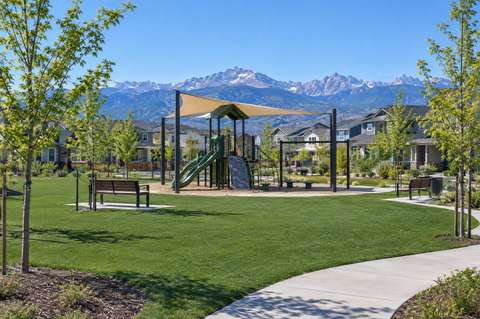
The Lakes at Centerra · Loveland, CO
Turf and putting greens in The Lakes at Centerra.
What the neighborhood’s own rules say about turf and putting greens. When you’re ready, we’ll walk the yard with you.

- 4.7 on GoogleRead the reviews
- Based in WindsorWorking Wellington to Longmont
- Plan and price in writingBefore any work starts
Before you start in The Lakes at Centerra.
- Artificial turf is allowed case by case with Design Review Committee approval.
- It can cover up to 45% of the lot’s landscaped area.
- The committee meets every two weeks, and 45 days without an answer counts as a no.
What we build.
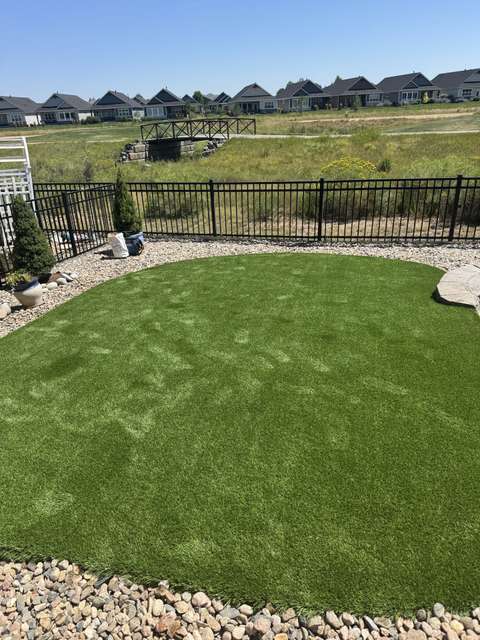
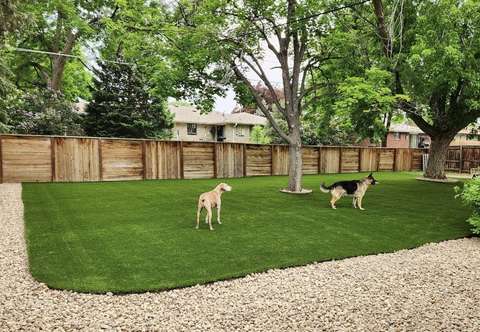
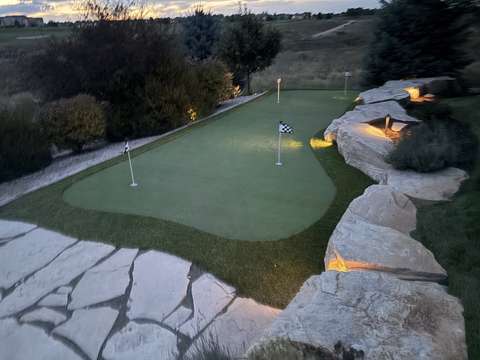
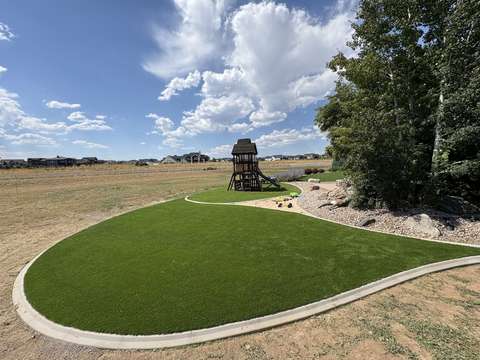


How it works.
Book a yard walk
Tell us about the yard. We’ll set a time to walk it with you, look at the ground and talk through what you want.
Get a plan and a price
We measure and give you the plan and the price in writing.
We install it
We take out the old lawn, build and compact the base for your soil, then lay, seam and edge the turf.
Walk it together
We brush it in, clean up, and walk the finished yard with you before we call it done.
More in Loveland.
Read up on putting greens.
Speed, break, cups, fringe and chipping: how to plan a backyard green you’ll actually use.
All 8 guidesCommon questions.
Can a dog run at The Lakes at Centerra be surfaced with turf?
The guidelines don’t say. They allow one pet enclosure per lot, none on attached townhome lots, up to 300 square feet and built against the house in the rear yard, or the side yard on lots 75 feet and wider, and they ask for ground cover “including gravel, mulch, crusher fines, etc.” Listed patio-home addresses are held to 10 by 25 feet. It depends on the DRC, so ask before planning turf inside the run.
Can my turf or plantings extend onto the common area behind my lot?
No. Residents may not plant, water, mow, mulch, prune or spray common area, and lot posts mark where the lot ends. Loveland’s development code, for its part, prohibits nonfunctional artificial turfgrass in the shared landscape areas of single-family developments. That ground is looked after by others: the metro district keeps Explorer Park, Frank Farms Park and district common landscaping, and the Master HOA, managed by MSI Property Management, handles the community amenities.
Can artificial turf run right up to the house?
The guidelines don’t settle it. Plants and irrigation are barred from the 5-foot backfill zone around the foundation, and the landscaped-area figure leaves that zone out of the count, but turf isn’t mentioned for it either way. It depends on the DRC, so show the zone on the plan, ask, and keep the lot’s approved drainage pattern intact.
I just bought at The Lakes. When does the yard have to be finished?
If the builder didn’t landscape it, within 180 days of the purchase when you bought between April 1 and October 1, and by the following October 1 otherwise. The DRC can extend that for bad weather or other constraints. The committee has up to 45 days to answer, so send a turf or putting-green plan in early in that window.
Does a Lakes yard plan also go to Centerra’s design review committee?
The Lakes guidelines send a homeowner’s change to The Lakes at Centerra’s own Design Review Committee. Centerra’s committee reviews development projects, but its page also says all improvements within Centerra, landscape and lighting included, reach it before any City application. It depends on the project: if yours needs a City of Loveland permit, ask the Lakes DRC whether Centerra’s committee must see it as well.
The fine printThe Lakes at Centerra’s design rules, in fullOpen
The Lakes at Centerra, on the record
- The place
- Lake community
- Design review
- The Lakes at Centerra Master Homeowners Association, Inc.Homeowners association
- Town
- Loveland, COLarimer County
Artificial turf gets its own section in the Lakes guidelines, and a 45% ceiling.
The section opens plainly: “Artificial Turf is permitted and will be reviewed on case by case basis.” Its second sentence caps turf at 45% of a lot’s total landscaped area.
That area is smaller than the lot. The text subtracts the house footprint, driveway, sidewalk and patio, and Figure 2.17B also removes a 5-foot foundation zone while counting the public right-of-way up to the back of the walk. On the figure’s 50-by-110-foot interior lot, 1,261 square feet survives the math, and the sample plan puts 561 square feet of it, 44%, in lawn. Single-family lots in the builder guidelines run from 45 by 105 feet up to 75 to 80 by 120, so measure the landscaped area before a green is sized against its 45%.
Section 2.17.4 sets the same 45% ceiling for irrigated lawn, and Section 2.17.11 asks for landscape plantings on at least 80% of the landscaped area, a share the sample plan reaches by counting its lawn with 452 square feet of beds. The guidelines don’t say whether lawn and artificial turf share one 45% or each get their own, or whether turf counts toward the 80%. It depends on how the DRC reads those sections together, so ask the DRC before a plan leans on either answer.
The document also predates Colorado’s 2023 backyard-turf law, printed below. Whether a percentage ceiling is the kind of design rule that law still allows behind a detached house is not something the guidelines settle; the HOA approval guide walks through how to ask.
Colorado law · the same in every town
On a detached home, an HOA can shape backyard turf. It can’t ban it.
Colorado law says an HOA's landscaping rules may not prohibit artificial turf in the backyard of a detached single-family home, although the HOA can still adopt design and aesthetic guidelines.
ASSOCIATIONS MAY ADOPT AND ENFORCE DESIGN OR AESTHETIC GUIDELINES OR RULES THAT APPLY TO DROUGHT-TOLERANT VEGETATIVE OR NONVEGETATIVE LANDSCAPES … EXCEPT THAT THE GUIDELINES OR RULES MUST: (A) NOT PROHIBIT THE USE OF NONVEGETATIVE TURF GRASS IN THE BACKYARD OF A UNIT OWNER'S PROPERTY
Read the signed actChecked Sep 24, 2026
Homes that share a wall
For attached single-family homes that share a wall, such as townhomes, Colorado law lets an HOA restrict artificial turf to rear yards only.
C.R.S. 38-33.3-106.5(1)(i)(I)(A)Front yards
Colorado law requires each HOA to pre-approve at least 3 water-wise garden designs for front yards, while its artificial-turf protection covers backyards only.
C.R.S. 38-33.3-106.5(1)(i.5)(II)Special districts
Colorado law makes unenforceable any HOA covenant or special-district rule that prohibits artificial turf in the backyard of a residential property, except for attached homes and timeshare associations.
C.R.S. 37-60-126(11)(a.5)If an HOA ignores it
If an HOA knowingly violates these Colorado landscaping protections, the homeowner must give written notice and 45 days to cure before suing for up to $500 or actual damages, whichever is greater.
C.R.S. 38-33.3-106.5(1)(i.5)(III)
Around the turf, the guidelines read like a planting and irrigation spec.
Artificial plants are prohibited outright, even though artificial turf is not. Gravel mulch with nothing growing in it tops out at 20% of the landscaped area and comes in brown, tan or gray, never red, white or black, and neither gravel nor wood mulch may run in big bare stretches across a front or side-corner yard. Wood mulch is brown only.
Water is designed in. Every lot needs an automatic irrigation system with its controller inside the garage, drip is strongly encouraged, and no zone should be built to need more than 22 inches of supplemental water in an average year, about 18 gallons a square foot, the tall-fescue benchmark. A lawn traded for turf still leaves beds and trees on that system. Nothing is planted or irrigated within 5 feet of the foundation, landscape work may not change the lot’s approved drainage pattern, and roof water has to sheet-flow, with no piped drain aimed at a neighbor or open space. A compacted turf base or a contoured green gets graded inside those lines.
Owners moving further from lawn can use Section 2.17.17’s Front Range appropriate option, where boulders, pavers and retaining walls count with plants toward an 80% share and the example plan strongly encourages lawn alternatives such as buffalo grass; done in a front yard, it needs a detailed drawing at the DRC first. The guidelines also invite every owner to a landscaping orientation at the High Plains Environmental Center, with sample turf grasses, shrubs, trees and native plants on hand.
The DRC meets every two weeks, and 45 days of silence counts as a no.
Once a home is finished and occupied, the committee set up under Article 6 of the Lakes covenants reviews every exterior change to the house and lot, and anything the guidelines don’t list needs its written approval too. Requests go in through the association’s resident portal or on paper, and staff send incomplete ones back unreviewed. The DRC meets biweekly; a request it hasn’t answered within 45 days of submittal is deemed denied, so an install date belongs after the approval letter, not the submission. Meeting every guideline still doesn’t assure a yes, since the document says it isn’t the committee’s only basis for deciding.
A home bordering common area posts a $2,000 refundable deposit with any landscaping application, returned after the association inspects the finished work, less any damage to the common area, and the guidelines suggest owners write that into their installer’s contract. A denial comes with reasons and can be revised and resubmitted, or appealed in writing within 30 days. A City of Loveland permit comes after the DRC’s approval, and a City approval doesn’t bind the committee.
One caution about the document itself. The public copy is dated January 12, 2021, Centerra’s design-review page lists only builder guidelines for The Lakes and sends residents to their resident website, and the association’s document library sits behind a login. Ask the DRC which version it applies before a plan is drawn.
On lots facing the lakes and open space, the yard is meant to be seen through.
Two lakes anchor the neighborhood, Houts Reservoir and Equalizer Lake, and High Plains Environmental Center land surrounds both. The Greeley Loveland Irrigation Company owns the reservoir and its water rights, HPEC holds the surface rights, and the guidelines say neither has to keep water levels up for recreation. Limited human contact is allowed on Houts Reservoir only.
The yard rules protect the view across a lot. Perimeter fencing is open cedar three-rail no taller than 4 feet, a lot backing onto common open space puts a gate in its rear fence line, and planting along open space should vary in height and leave view openings instead of forming a hedge. Where there’s no fence, lot posts mark the boundary, and residents may not water, mow, plant, mulch, prune or spray past it, so turf, edging and irrigation heads all stop at the lot line.
Night light is held back too: no uplighting or floodlights, full cut-off shielded fixtures, no more than 500 watts of low-level landscape lighting in all, and case-by-case review on lots next to environmentally sensitive areas, which matters when a green by the water is lit for evening putting. A path out to an HOA or metro district trail, though not to HPEC’s own, can be natural sandstone stepping stones up to 16 by 16 inches, set flush.
Patios, fire pits and walls each have a spec here; putting greens have none.
A design-led Lakes yard gets assembled from sections that each fix a material. Patios can be concrete, pavers, brick or stone. A permanent fireplace or fire pit is finished in masonry that blends with the house, sits in a side or rear yard or a front courtyard inside the building envelope, and stays within 8 feet. Retaining walls are Loveland/Masonville Buff sandstone or equal and stop at 4 feet unless a Colorado professional engineer designs a taller one, and a freestanding trellis or arbor tops out at 12 feet and 144 square feet, one per lot.
Section 2.30 is a single sentence: sport courts are not permitted. Play equipment, sports equipment included, stays in the rear yard, no taller than 9 feet and 5 feet off every property line. Putting greens appear nowhere, so a green falls under the rule that anything unlisted needs written approval. It depends whether the DRC counts a green inside the 45% turf ceiling or weighs it some other way, so draw its square footage, fringe and any chipping area on the plan and ask the DRC.
Design review · The Lakes at Centerra Master Homeowners Association, Inc.
What the guidelines say about turf and the backyard.
Quoted from the posted guidelines, each with the date it was read. Colorado’s backyard rule sits over all of them: what the law says.
The Lakes at Centerra's homeowner guidelines permit artificial turf, reviewed case by case, on no more than 45% of a lot's total landscaped area, which leaves out the house footprint, driveway, sidewalk and patio.
§ 2.17.5Checked Sep 26, 2026
The Lakes at Centerra's guidelines also hold irrigated lawn to no more than 45% of a lot's total landscaped area, to encourage water-wise landscaping.
§ 2.17.4Checked Sep 26, 2026
The Lakes at Centerra's guidelines prohibit artificial plants, cap gravel mulch without plantings at 20% of the landscaped area in brown, tan or gray only, and require landscape plantings on at least 80% of it.
§ 2.17.3Checked Sep 26, 2026
The Lakes at Centerra's guidelines do not permit sport courts and keep play equipment, sports equipment included, to rear yards, 9 feet tall at most and at least 5 feet from any property line.
§ 2.30Checked Sep 26, 2026
The Lakes at Centerra's Design Review Committee meets every two weeks, treats a request it hasn't answered within 45 days as denied, hears written appeals filed within 30 days, and takes a $2,000 refundable deposit with a landscaping application from any home bordering a common area.
§ 1.6Checked Sep 26, 2026
Sources for The Lakes at Centerra, Loveland, each with the date it was read6
- The Lakes at Centerra Master Homeowners Association, Homeowner Modifications & Design Guidelines (January 12, 2021), Secs. 1.1 to 1.7, 2.0, 2.7, 2.9 to 2.10, 2.14, 2.17, 2.18, 2.19, 2.22, 2.25, 2.30, 2.32, 2.33, 3.3, 3.8 and 3.10.3, Figures 2.17B to 2.17D · checked Sep 26, 2026
- The Lakes at Centerra Builder Design Guidelines (September 30, 2021), Figure 3.1, Product Segmentation · checked Sep 26, 2026
- Lakes at Centerra Consolidated Metropolitan District, About the District · checked Sep 26, 2026
- Centerra, Design Review page (Centerra Design Review Committee) · checked Sep 26, 2026
- C.R.S. 38-33.3-106.5(1)(i.5), added by SB23-178 (signed act) · checked Sep 26, 2026
- Loveland Unified Development Code, Sec. 18.08.02.04, Identification of Landscape Areas (Ord. 6819, effective March 17, 2026) · checked Sep 26, 2026
Next step
Let’s walk your yard.
Tell us what you want and how to reach you. We’ll set a time to see the yard.
Book a yard walk
Five quick questions. Then we’ll reach out to set a time.
- 1Your project
- 2Your town
- 3Size
- 4HOA and timing
- 5Contact